
I’ve always believed that if a computer can do something better, faster, and more accurately than a human can, then a computer should do it.
Let the machines do what they do best so people have more time to do the things that actually require people.
Way back in 1999, I created my first enterprise automation.
I was an engineering clerk (official title: production support) at MAC Equipment’s High Point, NC facility. MAC Equipment built custom-engineered industrial filtration and pneumatic conveying equipment.
One of my primary jobs was creating engineering packets for the fabrication, welding, and assembly/shipping departments. This consisted of printing a list of engineering line drawings for a piece of equipment, then entering those drawings into another system that would print them.
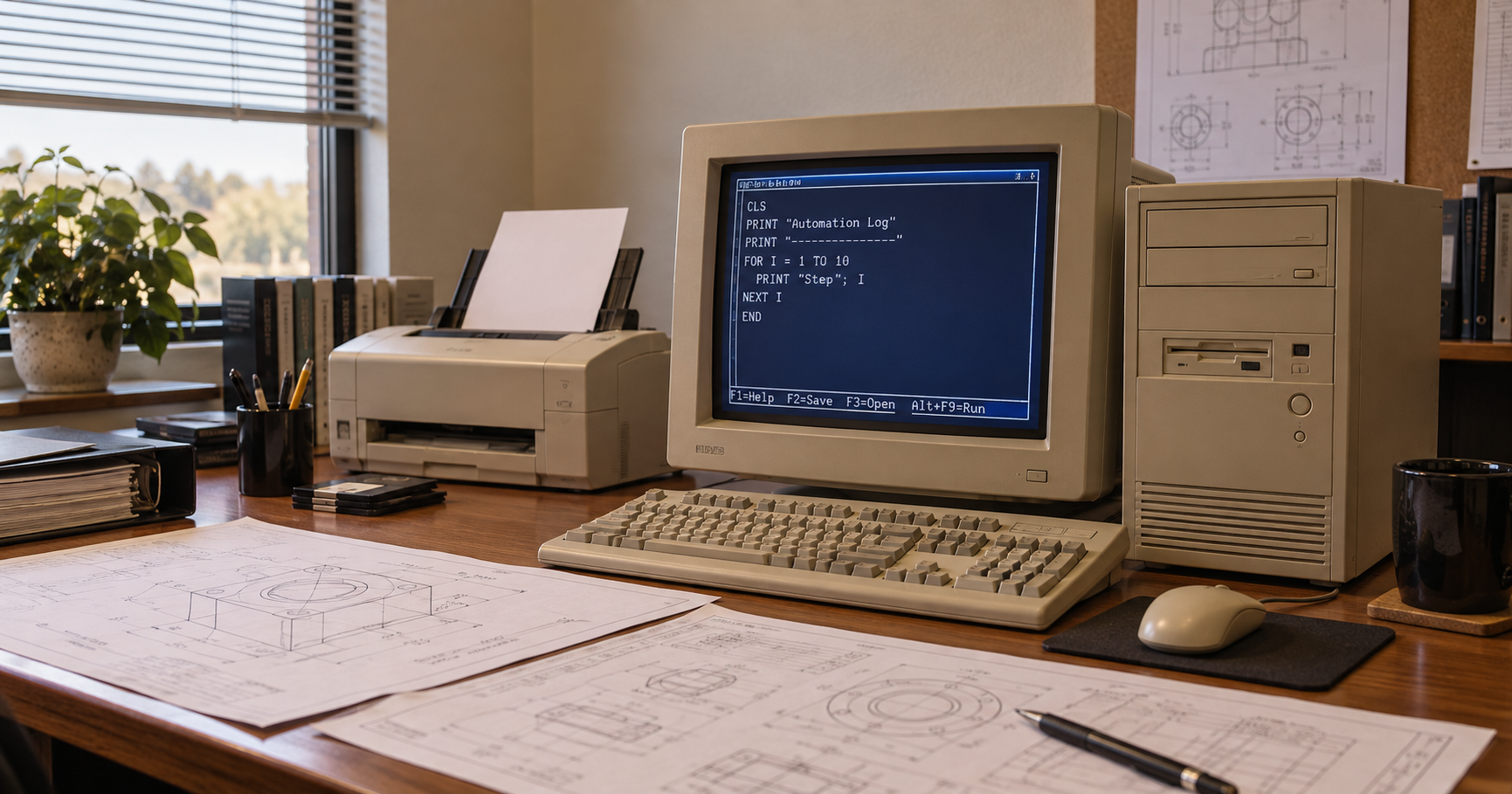
I realized that all that second system was doing was copying .pcl files containing HP Printer Command Language from the file server to the printer queue. I also realized that I could print the list of drawings to a file instead of to paper. So, I decided to eliminate the middleman—me.
I wrote an application in QBasic that would parse through the drawing list that had been printed to a file and copy those HP PCL files to the printer queue. This resulted in reducing a job that I did every day for 2 to 6 hours down to an average of 15 minutes a day. This gave me more time to focus on other aspects of my job.
The plant manager asked me to create a GUI program that did the same thing, but that was easier to use. They purchased a license for Visual Basic 6.0 and I rewrote the application in Visual Basic. The company then began using the program in our manufacturing facilities in Sabetha, Kansas; Kansas City, MO; and Houston, TX.
Shortly thereafter, the company eliminated my position. (I think this was a grave mistake on their part. I believe that a better option would have been to see what else I could automate. But, I wasn’t an IT person, so I guess they assumed that what I had done was all that I could do.)
With that, I had my first taste of enterprise automation, and that has been a hallmark of my career ever since.
After leaving MAC Equipment, I became the Webmaster for Allegacy Federal Credit Union. Although my initial job was to manage their website, I quickly found myself automating various operational processes. I automated one accounting process that saved 16 hours of staff time a week and a box of paper a month.
I left Allegacy to become an instructor and courseware author for SharePoint Solutions. One of the things I’m proudest of was writing the popular Mission Automation: SharePoint Workflow and InfoPath class. I taught hundreds of users how to use SharePoint, SharePoint Designer, and InfoPath to automate business processes. When I wasn’t teaching, I worked in the Consulting division helping organizations automate their processes.
When I left SharePoint Solutions, I became an independent SharePoint consultant. I continued using my skills to automate processes in organizations large and small with SharePoint, SharePoint Designer workflows, and InfoPath forms.
In 2020, I returned to the credit union industry and became the “Office Developer” for a small credit union: Winston-Salem Federal Credit Union. There, I discovered just how much opportunity there is for automation in even a small institution. I automated a payroll exception process from six hours down to 15 minutes. I developed a QA program that eliminated audit findings related to new memberships. After the credit union merged with a much larger institution, I automated the downloading of nearly 300,000 check images and saved the institution over $160,000 in deconversion fees.
I have spent my career finding work that computers should be doing instead of people—and developing the systems so the computers could do it.
This year, I have once again struck out on my own with CU Logics—an independent consultancy focused on helping small and midsized credit unions identify and automate manual operational work.
CU Logics brings together two threads that have run through much of my career: credit unions and automation.
Small and medium sized credit unions have no shortage of talented people. However, those talented people often spend too much of their day doing work a computer could do.
I want to change that.
Let the machines do what they do best. Let people do the rest.
Leave a Reply